Seedance 2 Now Supports 1080p Video Generation
Seedance 2.0 on Flixly generates 1080p video, and 4K too. This post covers what the higher resolution changes, how credit cost is quoted, and when it helps versus when it wastes credits.
TL;DR
Seedance 2.0 on Flixly offers 480p, 720p, 1080p and 4K output with clips from 4 to 15 seconds, and the app quotes the credit cost for your chosen resolution and duration before you generate. Higher resolution helps edge detail for full-screen viewing and further editing. Seedance 2.0 Fast tops out at 720p, and 720p is often enough for short social clips that platforms recompress.
The real question behind the 1080p update
Seedance 2.0 outputs 1080p video on Flixly. The detail that matters more is how that resolution fits your workflow and your credit budget when you run generations through Text to Video.
What the model offers
Seedance 2.0 sits in the high-resolution tier alongside Veo 3.1 and Kling 3.0. Flixly lists four resolutions for it: 480p, 720p, 1080p and 4K. The same text prompts work at every setting; 1080p simply returns frames at 1920 by 1080 instead of 1280 by 720.
Length and modes
Seedance 2.0 generates clips from 4 to 15 seconds. It supports text to video, image to video, reference to video, and first to last frame. The faster variant, Seedance 2.0 Fast, supports the same durations and modes but is limited to 480p and 720p.
Resolution impact on downstream tools
A higher-resolution clip gives later steps more to work with. Starting at 1080p in Image to Video means you're less likely to need an upscale pass in Video Tools, and edge detail holds up better when you chain the clip into Lip Sync.
| Model | Resolutions on Flixly | Durations | Credit cost |
|---|---|---|---|
| Seedance 2.0 | 480p, 720p, 1080p, 4K | 4-15s | quoted in-app |
| Seedance 2.0 Fast | 480p, 720p | 4-15s | quoted in-app |
| Veo 3.1 | 720p, 1080p, 4K | 4s, 6s, 8s | quoted in-app |
| Kling 3.0 | 720p, 1080p, 4K | 3-15s | quoted in-app |
| Wan 2.7 | 720p, 1080p | 2-15s | quoted in-app |
Credit cost
Higher resolutions cost more credits than lower ones on the same model, and longer clips cost more than shorter ones. Rather than guessing, check the quote the app shows before each run: change the resolution or duration and the quote updates.
Tradeoffs users actually notice
1080p makes on-screen text and fine texture easier to read, but files are larger and each run costs more. Character reference workflows depend heavily on the quality of your reference images; blurry or small references leave the model less detail to preserve, and that shows more at higher resolution.
When to stay at 720p
Most social platforms recompress uploads, so for short vertical clips the extra pixels often add cost without a visible gain. If your target is a quick social clip from the Video Generator, start at 720p, or use Seedance 2.0 Fast, and move up only if the result looks soft.
How to switch the setting
Open the generation panel, select Seedance 2.0, then choose the resolution before you hit generate. Confirm the updated credit quote first.
Decision rule
Choose 1080p or 4K when the final export will be viewed full screen or passed through further editing, for example after a Reference to Video run you plan to build on.
Frequently Asked Questions
What credit cost does Seedance 2.0 charge for a 1080p clip?▾
Cost depends on duration, resolution and settings, so there is no fixed price per clip. The app quotes the exact cost before you run the generation, and higher resolutions cost more than lower ones.
Does 1080p output from Seedance 2.0 keep the same character consistency as 720p?▾
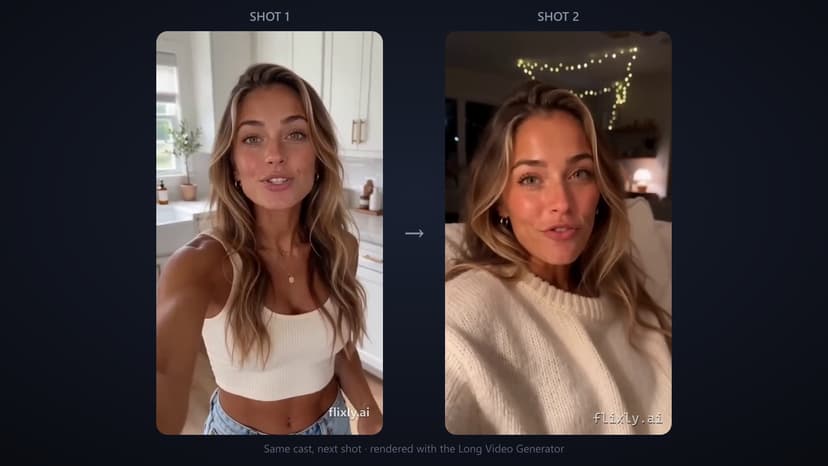
Character consistency depends mostly on your references and prompt, not the output resolution. Clear, well-lit, reasonably high-resolution reference images give the model the most detail to hold onto at 1080p.
Does Seedance 2.0 Fast support 1080p?▾
No. Seedance 2.0 Fast lists 480p and 720p only. Choose the standard Seedance 2.0 model for 1080p or 4K output.
How does Seedance 2.0 at 1080p compare with Sora 2?▾
On Flixly, Sora 2 is listed at 720p, while Sora 2 Pro offers 720p, 1024p and 1080p with durations up to 20 seconds. Seedance 2.0 goes up to 4K and 15 seconds. Run the same prompt on both in Compare to judge motion quality, and check each quote before generating.