GPT Image 2 Alternatives: 7 AI Image Models Worth Switching To
GPT-Image 2.0 renders text brilliantly, sits in the top price tier, and makes one image per request. Seven alternatives live in Flixly, and when to use each.
TL;DR
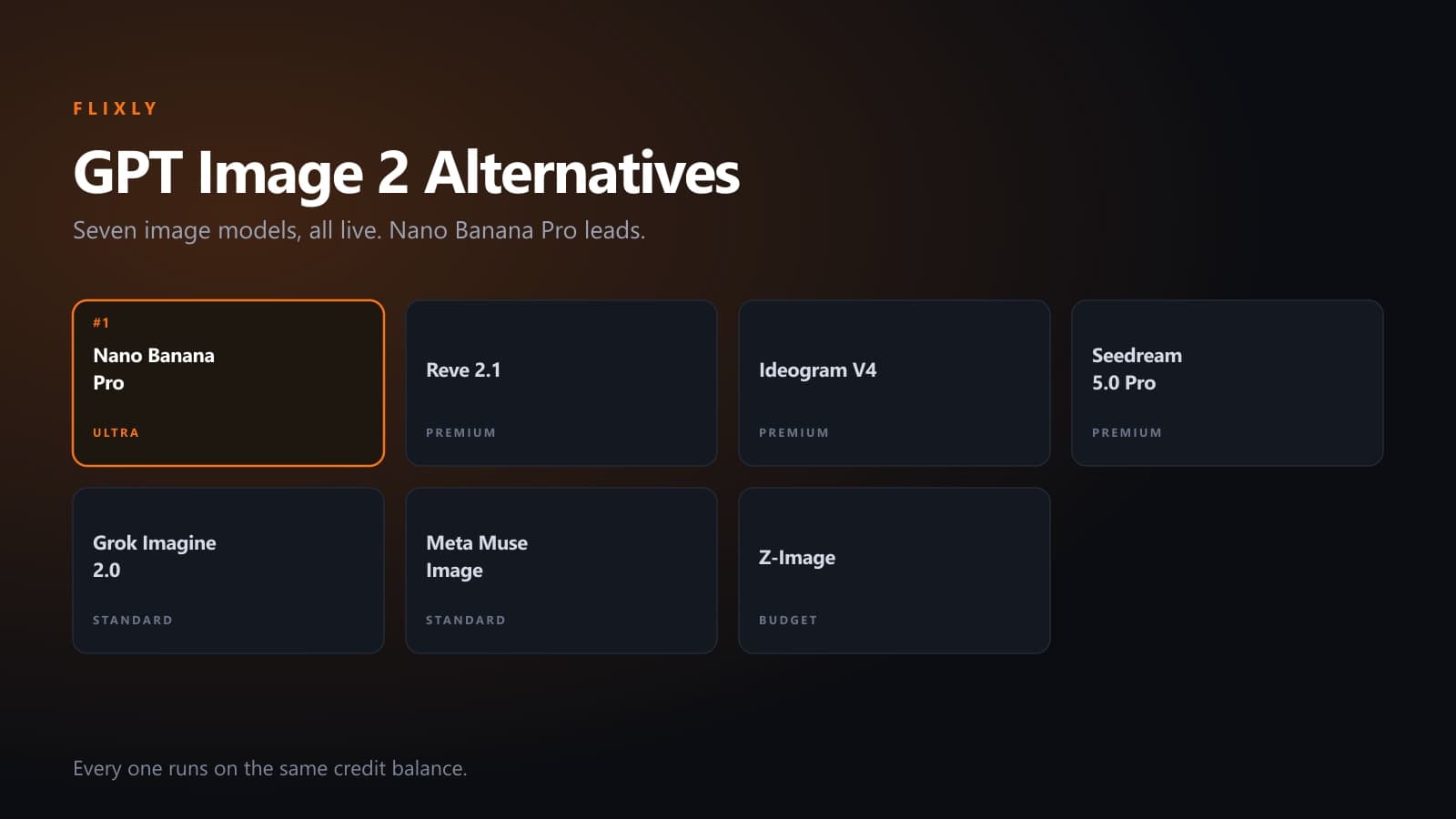
GPT-Image 2.0 is one of the best text renderers available, but it sits in the top ULTRA price tier and returns a single image per request. Nano Banana Pro is the closest upgrade: same tier, a higher catalog score, 14 tools against 13, and three registered capabilities to its one. Six other models cover typography, product work, framing, price and speed.
GPT-Image 2.0 renders text better than almost anything else you can point a prompt at. Its catalog entry claims above 99% accuracy, and it holds up: posters, UI mockups, infographics, Japanese and Korean captions a native reader won't wince at.
So most people set it once and run everything through it.
That's the expensive habit. It sits in ULTRA, the top tier, and it returns exactly one image per request. Both of those are fine for a hero image and wrong for the forty drafts you threw away getting there.
Forty-two image models run in production here. These are the seven worth knowing when GPT-Image 2.0 isn't the right call, ordered by how directly they replace it. Tiers below run BUDGET through ULTRA, and current credit costs sit on the pricing page.
1. Nano Banana Pro, the straight upgrade
Tier: ULTRA. Text-to-image, image-to-image, photo effects.
Start here, because on the catalog's own numbers this is a swap with no downside.
Same ULTRA tier, so you're not trading quality for price. It scores 96 against GPT-Image 2.0's 95. It's wired into 14 tools where GPT-Image 2.0 reaches 13, more than anything else in the catalog. And it carries three capabilities to GPT-Image 2.0's one: text-to-image, image-to-image and photo effects, where GPT-Image 2.0 is registered for text-to-image alone.
That breadth is the argument. One model covers generation, transformation and effects, so you're not switching mid-project and watching the style drift between steps.
It runs in about 15 seconds and turns up almost everywhere: text-to-image, photo effects, headshots, avatars, thumbnails, logos, social posts, product mockups, QR code art, book covers, memes, backgrounds, patterns and the landing page generator.
One thing to check yourself: GPT-Image 2.0's entry makes a specific multilingual claim, Japanese, Korean, Hindi and Bengali, that Nano Banana Pro's entry doesn't. If your work is CJK captions, run both before committing.
2. Reve 2.1, four options per prompt
Tier: PREMIUM. Text-to-image.
The catalog calls Reve the sharpest text renderer it has. That's a direct challenge on GPT-Image 2.0's headline strength, one tier cheaper.
What it adds is volume. Its spec carries a variation slider up to four per request, across every frame from square to widescreen, with layout and text placement holding across the set.
Four-at-once changes the loop. Instead of prompt, judge, adjust, re-prompt, you get a spread and pick. When you don't yet know what you want, that's faster than iterating one image at a time, and it's the single biggest workflow gap between this list and GPT-Image 2.0.
It's in text-to-image, thumbnails, logos, social posts, product mockups and book covers.
3. Ideogram V4, when typography is the design
Tier: PREMIUM. Text-to-image.
Ideogram built its name on in-image text, and V4 is the sharpest version of it.
Best-in-class text rendering, sharper typography, stronger prompt adherence, and three rendering speeds: TURBO, BALANCED and QUALITY. It's quick too, around six seconds.
That speed dial earns its place. Exploration wants fast and cheap; final output wants slow and sharp. One model covering both saves a switch mid-project.
So how do you choose between this and GPT-Image 2.0? Ideogram when the typography is the design, posters and logos and covers. GPT-Image 2.0 when the text sits inside a photorealistic scene.
Find it in text-to-image, thumbnails, logos, social posts, book covers and memes.
4. Seedream 5.0 Pro, built for commercial work
Tier: PREMIUM. Text-to-image, image-to-image, photo effects.
The one for work that has to sell something. Product visuals, design assets, dense layouts, commercial creative.
Its edit mode takes up to ten reference images, and that number is the point. Product photography means holding a specific object consistent across many shots. GPT-Image 2.0 accepts a reference image, singular, for guided generation. Ten references and a dedicated edit mode is a different capability, not a bigger version of the same one.
It's in text-to-image and photo effects.
5. Grok Imagine Image 2.0, for unusual framing
Tier: STANDARD. Text-to-image.
xAI's entry, two tiers below ULTRA, and the most flexible on shape.
A 2K option, a low/medium quality dial, up to four images per request, and thirteen aspect ratios running from ultrawide to ultratall. Thirteen is not a number most models offer, and it matters when one concept has to ship as a YouTube thumbnail, a story, a banner and a square post.
There's a Fast variant at a flat low price for exploring, and an Edit variant taking up to three images that composes, edits or restyles while holding identity.
Three models, one family, covering explore, generate and edit, all at STANDARD. They're in text-to-image, thumbnails, logos, social posts, book covers, memes and backgrounds.
6. Meta Muse Image, a cent an image
Tier: STANDARD. Text-to-image.
Faithful instruction-following and accurate fine detail: text, plots, diagrams and QR codes rendered rather than approximated. Nine aspect ratios, an image-count control, around eight seconds.
The number that earns it a place is the price. A flat $0.01 per image, no tiers, and its edit sibling takes one to ten reference images at the same rate.
Charts, diagrams and anything with a QR code in it are the obvious use. There's a fuller write-up of the model if you want the specs.
It's in text-to-image, thumbnails, logos and social posts.
7. Z-Image, two seconds and cheap
Tier: BUDGET. Text-to-image.
Tongyi-MAI's lightweight 6B model. Photorealistic output, roughly two seconds, notably accurate bilingual text in English and Chinese, Apache-2.0 licensed.
Speed is the headline. At that pace the model stops feeling like a request you wait on and starts feeling like a slider you drag, which changes what you're willing to try.
It's the cheapest image model in the catalog. Don't reach for it on final client work. Do reach for it when you need to see twenty ideas before committing to one, or when the copy is bilingual.
It's in text-to-image, thumbnails, logos, social posts, memes and backgrounds.
Also in the catalog
Seven is a shortlist. Forty-two is the catalog.
MAI-Image-2.5 (STANDARD) is Microsoft's general-purpose model, covering photorealism and in-image text at two tiers below ULTRA with up to four images per request. Cosmos 3 Super (PREMIUM) is NVIDIA's photorealistic flagship, and the only one here with agentic refinement: it generates several candidates per round and rewrites the prompt between them.
GPT-Image 2.0 Edit (ULTRA) is the dedicated editing sibling if you want to stay in the same family. Nano Banana 2 (PREMIUM) runs Gemini 3.1 Flash with web search and thinking modes. Kling O1 (ULTRA) is a reasoning model for image editing. FLUX Kontext Pro (PREMIUM) transforms an image without repainting the parts you liked.
Seedream 5.0 Pro Layer Decomposition splits an image into editable layers, each element its own transparent PNG. Image Translator localizes the text inside a poster or screenshot. And the Topaz upscalers, Precision, Wonder and Bloom, take any of the above up to 4x.
All of them are in the model catalog.
Picking one without overthinking it
| If you need | Use |
|---|---|
| The broadest single model | Nano Banana Pro |
| Four options per prompt | Reve 2.1 |
| Typography as the design | Ideogram V4 |
| Product and commercial shots | Seedream 5.0 Pro |
| Unusual aspect ratios | Grok Imagine Image 2.0 |
| Charts, QR codes, a cent an image | Meta Muse Image |
| Speed and volume | Z-Image |
The honest advice: pick two, run the same prompt through both, keep the winner. Comparisons written by other people are a starting point, not an answer, and your subject matter decides it more than any benchmark does.
You can switch models inside text-to-image without leaving the page, which makes that test cost about a minute.
If you came at this from the other direction, the Nano Banana alternatives list covers the same catalog from the opposite starting point, and there's a broader roundup of AI image generators if you want the field rather than the shortlist.
Frequently Asked Questions
What is the best GPT Image 2 alternative?▾
Nano Banana Pro is the closest like-for-like swap. It sits in the same ULTRA tier, scores 96 in the Flixly catalog against GPT-Image 2.0's 95, is wired into 14 tools rather than 13, and is registered for text-to-image, image-to-image and photo effects where GPT-Image 2.0 is registered for text-to-image.
Can GPT-Image 2.0 work from an existing image?▾
Yes. Its input spec includes a Reference Image field for guided generation, and the Image to Image tool routes to text-to-image in image mode where you can supply one. There is also a separate GPT-Image 2.0 Edit model in the catalog, same ULTRA tier, built for precise single-image edits with detail preservation.
Are there cheaper GPT Image 2 alternatives?▾
Yes. GPT-Image 2.0 sits in ULTRA, the top tier. Grok Imagine Image 2.0 and Meta Muse Image cover text and photorealism at STANDARD, two tiers down, and Meta Muse is a flat cent per image. Z-Image is the budget option at roughly two seconds. Current credit costs are on the pricing page.
Which alternative is best for text inside images?▾
Reve 2.1 is described in the catalog as its sharpest text renderer, and Ideogram V4 leads on in-image typography with three rendering speeds. Choose Ideogram when the typography is the design itself, and GPT-Image 2.0 or Nano Banana Pro when text sits inside a photorealistic scene.
Which models return more than one image per prompt?▾
Reve 2.1, Grok Imagine Image 2.0 and Meta Muse Image all expose an image-count control and return up to four per request. GPT-Image 2.0 has no such control in its spec, so one request produces one image. That is a workflow difference rather than a quality one.
How many image models does Flixly have?▾
Forty-two image models are live in production, spanning BUDGET through ULTRA tiers. They cover text-to-image, image editing, photo effects, upscaling, layer decomposition and in-image translation. All of them run on the same credit balance with no separate signup.
Which model is best for product photography?▾
Seedream 5.0 Pro targets product visuals, design assets and commercial creative, and its edit mode accepts up to ten reference images. That matters because holding one specific product consistent across many shots needs more than a single reference to work from.